|
|
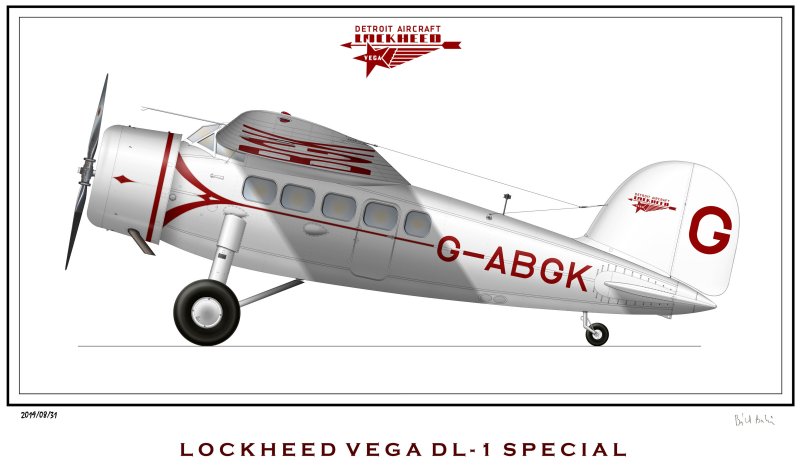
(Artwork
by Balázs Bálint)
VH-UVK Puck
|
 |
 |
 |
 |
 |
| Type: | DL-1A Vega Special |
| MSN: | 155 |
| Previous Identities: | NC372E G-ABFE G-ABGK |
| Subsequent Identities: | A42-1 |
| 30 | Built by Detroit-Lockheed, with a metal fuselage and Pratt and Whitney Wasp SC1 engine. It was later registered NC372E. |
| 30SEP30 | Registered as G-ABFE to Lieutenant Commander Glen Kidston of London. Kidston intended to build Vegas under licence in the U.K. |
| JAN31 | Shipped to the U.K. |
| 03JAN31 | Re-registered G-ABGK at the request of the owner to incorporate his initials. |
| 17JAN31 | British CofA No V45 issued. |
| 31JAN31 | Test-flown by Kidston from Croydon Aerodrome, London. |
| 14FEB31 | A local training flight was made from Croydon by Kidston and his partner Lieutenant Owen Cathcart-Jones along with two other crew. |
| 20FEB31 | Another local training flight was made from Croydon. |
| 21FEB31 | Flown from Croydon to le Bourget, Paris in the record time of 1 hour 12 minutes. The aircraft returned to Croydon two days later. |
| 19MAR31 | Test-flown at Croydon after installation of long range tanks. |
| 28MAR31 | The Vega was positioned from Croydon to Netheravon. |
| 31MAR31 | Kidston and Cathcart-Jones departed Netheravon on an attempt to break the Capetown record. Routing was Naples, Malta, Cairo, Kosti, Malakal, Kisumu, Salisbury, Bulawayo and Pretoria. A wireless operator, T.A. Vallette on loan from the Marconi Company, joined the flight as far as Cairo. At Cairo his place was taken by an engineer, G.W. Hills. |
| 05APR31 | Forced landing at Lichtenburg, Pretoria due engine trouble. The propeller was damaged when the Vega ran through wire fences. The aircraft later departed for Capetown. |
| 06APR31 | Arrived Capetown in the record time of 6 days 9 hours at an average speed of 134 mph. |
| 05MAY31 | Lt Cdr Kidston and Capt T.A. Gladstone were killed in the crash of Puss Moth ZS-ACC in the Drakensberg Mountains in South Africa. |
| 05DEC31 | The Vega was test-flown at Hamble, U.K. having been shipped back from South Africa. The aeroplane was flown to Hanworth by Cathcart-Jones the same day. The Vega was administered by a trust set up by the Kidston family. |
| 12APR32 | Cathcart-Jones flew the Vega during Sir Alan Cobham's National Aviation Day Display at Hanworth and later toured various air pageants throughout the U.K. |
| 28MAY32 | The Vega attended the Guild of Air Pilots Civil Air Day. |
| 19JUN32 | The Vega was demonstrated at the Royal Aeronautical Society's Garden Party. |
| 17JUL32 | Cathcart-Jones flew the Vega to Stoke and return. |
| 08AUG32 | The Vega was flown from Hanworth to Belfast. |
| 22AUG32 | The Vega returned from Belfast to Hanworth via Dublin. |
| 05OCT32 | The Vega visited Dublin. |
| 25OCT32 | Cathcart-Jones demonstrated the Vega to His Highness the Maharajah of Jodhpur and to Sir Frank Spickwell of Imperial Chemical Industries with a view to selling the aeroplane, but no sale was concluded. |
| 24MAR33 | Cathcart-Jones flew the Vega from Hanworth to Liverpool and return after which the aeroplane was hangared at Hanworth awaiting sale. |
| 15AUG34 | Test-flown at Hanworth by Capt James Woods on behalf of the new owner, Australian Horrie Miller who intended to enter the Vega in the Centenary Air Race from England to Australia. |
| 16AUG34 | Woods flew the Vega from Hanworth to Heston and Rotterdam where the engine was to be overhauled and a new propeller fitted by KLM at Waalhaven. |
| 14SEP34 | The Vega returned to Heston. |
| 20OCT34 | The Vega positioned from Heston to Mildenhall to join the Centenary Air Race. It departed Mildenhall at 0639 crewed by Jimmy Woods and Don Bennett and carrying the race number 36. (Australian D.C.T. Bennett later founded the famed "Pathfinder Force" and eventually rose to the rank of Air Vice-Marshal). The Vega was named "Puck" in honour of the late Hugh "Puck" Grosvenor, Aide-de-Camp to the South Australian Governor and a personal friend of Horrie Miller. The Vega flew from Mildenhall to Marseilles, Rome and Athens where it overnighted. |
| 21OCT34 | Departed Athens for Aleppo, Syria where the Vega landed heavily collapsing the undercarriage and overturning. Although injured, both pilots walked away from the wreck. With no hope of completing the race, Bennett returned to the U.K. and Woods stayed with the aircraft pending receipt of funds to ship it to Australia. |
| JAN35 | The Vega arrived at Fremantle, W.A. and was trucked to the MacRobertson Miller Aviation Company's workshops at Maylands Aerodrome in Perth for repairs which lasted eight months. |
| 22AUG35 | The Vega was test-flown at Maylands, W.A. by Horrie Miller. As the Vega was not a British aircraft, there ensued a long dispute regarding the aeroplane's CofA. In the interim, the Vega was approved to operate under its British CofA. |
| 05OCT35 | Capt Woods flew the Vega in the Perth Aerial Derby beating an RAAF Hawker Demon! |
| 13OCT35 | The Vega departed Perth for Adelaide via Kalgoorlie, Forrest and Ceduna under the command of Capt Woods on its first commercial service. |
| 20OCT35 | The Vega departed Adelaide on its return flight but was delayed for two days at Forrest while the airstrip dried out. |
| 19JUN36 | The Vega was test flown by Horrie Miller prior to formal issue of an Australian CofA. |
| 23JUN36 | Registered VH-UVK to H.C. Miller of Perth, W.A. (CofR No 540). (Horrie Miller had earlier requested the registration VH-BGK to minimise repainting but his request was denied.) The Vega was used for charter flights and for communications between MMA bases at Perth and Adelaide. It was occasionally used to pickup mails from delayed flights. |
| 05OCT36 | The Vega flew from Perth to Adelaide, returning on October 9th. |
| 14OCT36 | The Vega operated a charter flight to Kalgoorlie. |
| 17NOV36 | The Vega operated a charter flight from Kalgoorlie to Adelaide, returning to Perth three days later. |
| 09JAN38 | Horrie Miller flew the Vega in the Aerial Derby at Maylands. |
| 05MAY38 | Horrie Miller flew the Vega to the newly built RAAF Base at Bullsbrook (later RAAF Pearce). |
| 10NOV38 | Capt Woods flew the Vega to Darwin returning three days later. |
| 13APR40 | The Vega spent the day joyriding. |
| 02JUN41 | Horrie Miller flew the Vega to Geraldton, returning the following day. This was the aircraft's first long distance flight since returning from Darwin in November 1938, the aeroplane having been hangared for much of this time. |
| AUG41 | MMA applied to have the Vega included on their airline licence as wartime impressments by the RAAF had depleted the MMA fleet. However, the Vega was destined never to enter airline service with MMA, for it too was about to be impressed. |
| NOV41 | The Vega was taken over by the RAAF under Impressment Requisition No 9020. Prior to being released to the RAAF, the Vega was given a CofA overhaul by MMA at Maylands. At this stage, the aeroplane had only 246 hours in its logbook. |
| 11NOV41 | The Vega was ferried from Perth to Laverton, Victoria where it was accepted by the RAAF at No 1 Aircraft Depot. |
| 12NOV41 | The Vega came on charge to the RAAF as A42-1. It was painted in camouflage and issued to Northern Area HQ to whom it was delivered in late December. |
| 17JUN42 | The Vega ground-looped on landing at Cairns, Queensland and incurred serious wing damage. The aircraft was trucked to Townsville where it was stored by No 24 Squadron and later by No 33 squadron. |
| 12OCT42 | Received by Aircrafts Pty Ltd at Archerfield, Brisbane for repair under contract to the RAAF. |
| 10NOV43 | Repairs were completed. |
| 24NOV43 | The Vega was issued to No 3 Communication Unit. |
| 09MAR44 | The Vega was issued to the Department of Civil Aviation for disposal having been declared surplus by the RAAF. DCA had intended to issue the aeroplane to Ansett Airways, but as a result of reports by RAAF pilots that the Vega had longitudinal instability problems, the DCA decided that the aeroplane should remain in storage with 3CU at Mascot. |
| OCT44 | The Vega was still stored at 3CU awaiting a new engine and other maintenance. DCA recommended to the RAAF that the aeroplane be scrapped. |
| 28AUG45 | Butler Air Transport expressed interest in acquiring the Vega from DCA. |
| 17SEP45 | Conversion to components approved. |
| 12OCT45 | The Vega was allotted to No 2 CRD at Richmond, New South Wales for conversion to components. The aeroplane was dismantled at Mascot and trucked to Richmond. |
| 15OCT45 | Capt James Woods advised DCA that he wished to purchase the Vega. DCA replied that the Vega was to be scrapped because of instability problems. This action was protested by Capt Woods who indicated that he had flown the aeroplane more than anyone else in Australia and was fully aware of its capabilities. DCA replied that they would not renew the Vega's CofA. By this time, the Vega had been chopped up with axes at Richmond RAAF Base. Thus ended the career of Australia's only Lockheed Vega. |
| 30JAN73 | Horrie Miller wrote to the Department of Defence in Canberra indicating that he had no record of having received any acknowledgement of the military impressment of the Vega nor was he ever compensated for the loss of the aircraft. Horrie Miller's letter was evidently prompted by an erroneous report that the Vega was held by the RAAF Museum at Point Cook! (It would appear, furthermore, that the aeroplane was never offered back to Horrie Miller!) |
| Issue | Date | Remarks |
|---|---|---|
| 4 | 22FEB22 |
Added
a second image of G-ABGK after its crash at Aleppo. Also corrected
the attribution for the first image. Both images are by James
Woods via the Frank Colquhoun Collection via Ted Fletcher and
Geoff Goodall.
|
| 3 | 20SEP19 |
Added
a superb colour painting of the aircraft as G-ABGK thanks to
Balázs Bálint.
|
| 2 | 31MAR16 |
Refreshed
layout. No change to data.
|
| 1 | 13AUG99 |
Original
issue
|
Special thanks to Geoff
Goodall, whose research predominates on this page.
Thanks also to Ted Fletcher for supplying the photographs.
|
REFERENCES
|
| "Vega
VH-UVK The Story of a Unique Aeroplane" Geoff Goodall (Journal of the Aviation Historical Society of Australia Vol 17 No 4) |
| "The
Civil Aircraft Registers of Great Britain 1919-1985" John Appleton (TAHS 1986) |
| "The
Historic Civil Aircraft Register of Australia (Pre War) G-AUAA
to VH-UZZ" Bert Cookson (AustAirData 1996) |
| "Revolution
in the Sky " Richard Sanders Allen (The Stephen Greene Press 1967) |
| "Lockheed
Aircraft since 1913" Rene J. Francillon (Putnam 1987) |
| "A
Rich Man's Toy - The Log of a Lockheed Vega" James Ritchie Grant (Classic Wings Downunder No 19) |
| "Aviation
Heritage - The Centenary Air Race" Vol 24 No 1 & 2 (Aviation Historical Society of Australia 1985) |