1PRU

Australia's association with the Lockheed Lightning had its beginnings in August 1942 when two batches of F-4 photographic reconnaissance variants of the P-38E arrived in Melbourne by sea. As will be seen from the following table, nine F-4s were received at the Commonwealth Aircraft Corporation (CAC) factory at Fishermens Bend. Whilst the majority of these aircraft were for the USAAF's 8th Photo Reconnaissance Squadron (8PRS), certainly one and probably another of the aircraft were allocated to the Royal Australian Air Force (RAAF).


CAC
USAAF
RECEIVED
DELIVERED
REMARKS
1
41-2098
12AUG42
02SEP42
8PRS
2
41-2159
12AUG42
23AUG42
RAAF as A55-2?
3
41-2158
12AUG42
31AUG42
RAAF as A55-1
4
41-2130
12AUG42
02SEP42
8PRS
5
41-2137
19AUG42
02SEP42
8PRS
6
41-2139
19AUG42
02SEP42
8PRS
7
41-2156
19AUG42
03SEP42
8PRS
8
41-2177
19AUG42
05SEP42
8PRS
9
41-2140
19AUG42
11SEP42
8PRS

Source: Compiled by a CAC employee, Bill Audsley, and published in "Aviation Heritage" the journal of the Aviation Historical Society of Australia (AHSA) Vol 22 No 4. The Remarks column has been added by the author.


AIRCRAFT IDENTITIES

Whilst it is known that the RAAF initially received two F-4s, there is some doubt over their identities. A third aeroplane was subsequently delivered as an attrition replacement and again there is some doubt over its identity. A list of RAAF Lightnings published by the Aviation Historical Society of Australia in 1978 presents mismatched Manufacturer's Serial Numbers (MSN) and USAAF serials. The ultimate source of this information has thus far eluded the author so it has not been possible to determine if the list was based on "known" MSNs or "known" USAAF serials or even a mixture of both! Indeed, the only source of primary information to come to light are the status cards (RAAF Form E/E88) for the three aircraft in question. Cards for two of the three Lightnings (A55-1 & A55-3) include the USAAF serials shown in the following table. It should be noted that these USAAF serials were typed on the cards when they were initially raised i.e. they are not retrospective additions. There is no USAAF serial shown for the other aircraft (A55-2). Although there are compelling reasons for accepting the identities shown in the following table, there are some unresolved anomalies and therefore these identities must be regarded as provisional.


RAAF SERIAL
USAAF SERIAL
MSN
REASONING
A55-1
41-2158
5376
This USAAF serial is typed on the RAAF status card. The delivery date ex CAC matches exactly the date of receipt by the RAAF. Terry Geary in the United States has searched the Aircraft History Cards for the nine F-4s which were erected by CAC in August 1942. The cards for 41-2158 and 41-2159 are both endorsed "diverted to Australia 25 Aug 42". Given that none of the other seven cards are similarly endorsed, this would appear to confirm that A55-1 was previously 41-2158 as stated on the RAAF status card.
A55-2
41-2159
5377
Although the RAAF status card does not record a USAAF serial, this aircraft was erected by CAC but apparently did not serve with the 8PRS. 41-2159 was delivered ex CAC on 23AUG42 and A55-2 was received by the RAAF on 04SEP42. The apparent time lapse is not necessarily significant (perhaps waiting for a pilot?) Terry Geary in the United States has searched the Aircraft History Cards for the nine F-4s which were erected by CAC in August 1942. The cards for 41-2158 and 41-2159 are both endorsed "diverted to Australia 25 Aug 42". Given that none of the other seven cards are similarly endorsed, this would appear to confirm that A55-2 was previously 41-2159.
A55-3
41-2122
5340

This USAAF serial is typed on the RAAF status card. There remains, however, conflicting information that this aircraft was also written off by the 8PRS. Terry Geary in the United States has examined the Aircraft History Card for F-4 41-2122. The card shows that 41-2122 was condemned by the 5th Air Force at Brisbane on 5th December 1943 after a non-combat accident. This would tend to suggest that it was 41-2122 which became A55-3 and that it was not this aircraft which was being flown by Flight Officer Fred Cross of the 8PRS when he went missing in action on 5th December 1943.

A document dated 4 August 1943 from Air Member for Supply and Equipment to No 5 Maintenence Group, RAAF listing aircraft received in Australia from the USA and the NEI states that three F-4s were delivered to the RAAF (see below). They are identified as 41-2144, 41-2158 and 41-2159. As the latter two almost certainly became A55-1 and A55-2 respectively, this document implies that A55-3 could have been formerly 21-2144. Nevertheless, the status card for A55-3 is clearly endorsed as 41-2122. Despite the fact that this is the only reference to 41-2144 sighted by the author and is most probably an error, it cannot be discounted because of conflicting information that 41-2122 was lost in action by the 8PRS.


INTO SERVICE

Although the first two Lightnings for the RAAF, A55-1 and A55-2, were received at No 1 Aircraft Depot (1AD) Laverton on 31st August and 4th September 1942 respectively, it was not until 30th October that both aeroplanes departed Laverton on delivery to No 1 Photographic Reconnaissance Unit (1PRU) at Hughes in the Northern Territory. As might be expected when operating a small number of sophisticated aircraft in such a remote location, there were numerous unserviceabilities, principally with the turbo superchargers, intercoolers and the cameras themselves. A significant event which precipitated the delivery of a third Lightning to 1PRU was the fatal crash of A55-2 on 20th November 1942. Although some sources report that this aeroplane was ultimately returned to the USAAF, there is an RAAF crash report and photographic evidence to confirm that the aeroplane was destroyed in RAAF service. (Although it is not possible to discern an identity in this photo, the crash site and burned out wreckage depicted are clearly different from those of the other two Lightnings).

By early December, 1PRU had relocated to Coomalie Creek, also in the Northern Territory. A replacement Lightning was obtained from the USAAF's 8PRS and this aeroplane was delivered to 1PRU as A55-3 on 16th March 1943. The RAAF Form E/E88 for A55-3 shows its previous identity as 41-2122 and this is the identity which has been provisionally assigned to the aeroplane in the above table. However, there is a complication in that 41-2122 is reported to have crashed while in service with the 8PRS on the 5th December 1943 near Hood Point killing the pilot, Flight Officer Fred Cross. This leaves us with the scenario of two different air forces claiming to have lost the same aeroplane (41-2122) a matter of days apart (USAAF on 05DEC43 and RAAF on 10DEC43). However, Terry Geary in the United States has examined the Aircraft History Card for F-4 41-2122. The card shows that 41-2122 was condemned by the 5th Air Force at Brisbane on 5th December 1943 after a non-combat accident. This would tend to suggest that it was 41-2122 which became A55-3 and that it was not this aircraft which was being flown by Flight Officer Fred Cross of the 8PRS when he went missing in action on 5th December 1943.


UNSERVICEABILITIES

As mentioned previously, the Lightnings were beset with unserviceabilities and this is reflected in an exasperated signal from 1PRU to RAAF HQ on 22nd March 1943, less than a week after the replacement aircraft had arrived: "Lightning A55-3 intercooler system unserviceable. After only 16 hours flying. Modifications unsuitable this climate." In August, another signal advised that: "It is seldom possible to have both Lightnings serviceable at the same time." This signal was followed up four days later with a list of parts required:

Exhaust manifold left and right two off each.
Phillips screws 10/32 SAE one inch long counter-sunk heads three gross.
Trunk connecting rubber from intercooler to carburettor twenty-four off.
Hose cylinder head coolant eight off.
Hose coolant forty eight off.
Hose coolant two and a half by four inches long sixteen off.

Despatch of these parts was confirmed on 4th September 1943 and yet just thirteen days later, HQ North Western Area (NWA) was advising RAAF HQ that the remaining two Lightnings were beyond repair within area facilities and that obtaining spare parts from American sources in Townsville was not the answer. The predicament was further emphasised: "No successful operational flight has been carried out since 11 Aug (to 17th September. Ed.). Result is that PRU work falls upon heavy bombers thus reducing the effectiveness of their striking power." The signal concluded that the aircraft were beyond repair and suitable only for conversion and called for replacement aircraft, either F-5 Lightnings or Mosquitoes. The very next day (18th September 1943) RAAF HQ advised that replacement F-4s were not available and that arrangements had been made for a "complete overhaul first priority by USAAF". NWA were asked if both Lightnings could be flown to Townsville. Evidently these "arrangements" had been made at a very high level because the RAAF HQ files include a note on stationery "From the Desk of Lt. Gen. George C. Kenney" addressed to Col. Victor E. Bertrandis, Commanding Officer, Advanced Echelon, Fifth Air Force Service Command, Townsville with the succinct and un-signed hand-written message: "2 P.38's for 1PRU to be repaired there." NWA responded just two days later to say that A55-3 had departed for Townsville and that A55-1 would follow as soon as the parts despatched to 1AD for overhaul were received. A55-3 returned to 1PRU on 1st November 1943 and four days later A55-1 departed for Townsville.

While A55-1 was undergoing overhaul in Townsville, disaster struck on 10th December 1943 when A55-3 belly-landed owing to an undercarriage malfunction. This desperate situation prompted NWA to enquire if one or both of the F-4s loaned to 75SQN might be available. (These two Lightnings, 41-2220 and 41-2156, completed their loan to 75SQN on 21st December 1943). It was also stated that even if A55-1 remained serviceable after its return from overhaul, 1PRU would be left with just one Lightning and one Wirraway as the only aircraft capable of photo reconnaissance.

New Year's Day 1944 brought the news that A55-1 had departed Townsville only to return with an engine shut down. It was not until 6th January 1944 that A55-1 finally returned to 1PRU. In the meantime, the plea to take over the two 75SQN Lightnings had brought the news that all remaining F-4s "have been grounded and reduced to components for salvage. They are unsafe for flying. It appears that there is no possibility of any Lightning type P.R.U. aircraft becoming available before the Mosquitoes." Despite this advice, a memo dated 6th February 1944 from the Assistant Chief of Staff of the Fifth Air Force, instructed Service Command to "turn-over three F-4s which are awaiting salvage to RAAF on lend lease considerations." Two days later, it was advised that the aircraft in question were 41-2130, 41-2139 and 41-2217. Subsequent correspondence states that these three aircraft were allotted to the RAAF in accordance with a Fifth Air Force HQ memorandum dated 8th February 1944. On 31st March 1944, a memo states that the three Lightnings were being prepared for flight at Port Moresby. A later memo confirms that two of the aircraft had arrived at Amberley on 15th May 1944 and the third had force-landed at Rockhampton. The identities of the two aircraft which arrived at Amberley are quoted as 41-1217 and 41-2156. It is reasonable to assume that the former was a typographical error intended to be 41-2217 as 41-1217 was not allocated to a Lightning. The latter aircraft, 41-2156, is evidently a substitution, although it is not possible to say which aircraft it was replacing because the identity of the Lightning which diverted to Rockhampton is not known. Ironically though, 41-2156 was one of the two Lightnings previously loaned to 75SQN which NWA had asked for and been denied nearly six months earlier!

What might have been a promising development for 1PRU came to an end on 22nd May 1944 when the Commanding Officer of RAAF Forward Echelon advised the Director of Operations of the Fifth Air Force that the condition of the two aircraft ferried to Amberley had deteriorated since negotiations began. "Owing to the large amount of corrosion and wear it is considered uneconomical to bring these aircraft to a serviceable condition and it is recommended they be converted to salvage. It is understood the third F-4 forced landed at Rockhampton and is in similar condition." The final death knell for what might have been A55-4, A55-5 and A55-6 came on 25th May 1944 when the Fifth Air Force Service Command were instructed by HQ Allied Air Forces per command of Lt Gen Kenney to "terminate negotiations" and "make recommendations for the disposition of the airplanes."

Lightning operations by 1PRU effectively came to an end on 1st September 1944 when their last surviving F-4 (A55-1) was damaged beyond repair in a landing accident at Coomalie Creek. A request from NWA for an immediate replacement brought the following response from RAAF HQ on 5th September 1944: "no replacement Lightnings available and do not propose bidding for them in view of replacement by Mosquito."

Indeed, the first P.R. Mosquito, A52-2, had earlier arrived at Coomalie Creek on 29th May 1944 and entered service three days later.

On 10th September 1944, 1PRU became No. 87 Squadron under the command of Squadron Leader L.W. Law, still based at Coomalie Creek.
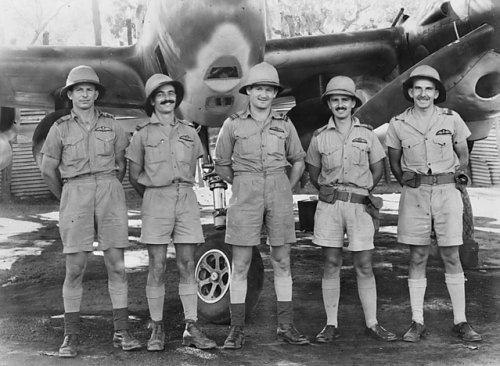
RAAF Lightning operations were not restricted to 1PRU. Please see 75 Squadron.

This section draws upon correspondence from the files of RAAF Command HQ held in the National Archives of Australia (Series A11093 Item 3081559)


Full histories and photographs of the 1PRU Lightnings
can be found on individual pages for each aircraft.


COLOURS AND MARKINGS - 1PRU

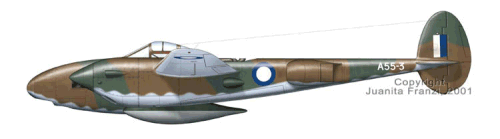
This profile of A55-3 was drawn by noted aviation artist, Juanita Franzi. It shows the aeroplane in dark earth and dark green with sky blue undersurfaces. The above image is linked to a larger version.


Given that the first practical application of Haze Paint was on the Lockheed F-4 Lightning, it is more than likely that the two F-4s which ultimately went to the RAAF as A55-1 and A55-2 would have been received at CAC in Haze Paint. However, all available evidence suggests that when these aircraft entered service with 1PRU they were finished in dark earth and dark green upper surfaces and sky blue under surfaces. Perhaps by this time the difficulties in maintaining the Haze finish were well known and the RAAF opted for normal camouflage. Certainly there would have been ample time to repaint the two aircraft as both did not enter service with 1PRU until approximately two months after being received at 1AD ex CAC. By way of contrast, the 8PRS Lightnings were in service within a day or two of having been released from CAC.


View all three of Juanita Franzi's Lightning profiles on one page.

www.aeroillustrations.com


If you can contribute any additional information, particularly if you can clarify the identities of the RAAF Lightnings, please email the author ron@adastron.com


Special thanks to Nev Rourke for Geoff Atherton's photos and logbook extracts.

Thanks also to:

Rich Faulkner
Juanita Franzi
Terry Geary
John Hopton
Bob Livingstone
Peter May
Mike Nelmes
Lawrence Packard.


Issue Date Remarks
8 12AUG11
Added a reference to 41-2144 being a possible previous identity for A55-3.
7 18FEB04
This section has been greatly expanded with new material drawn from the files of RAAF Command HQ held in the National Archives of Australia Series A11093 Item 3081559. With thanks to Peter May. There are now separate pages for 1PRU and 75SQN.
6 04JAN04
Added further evidence to suggest that A55-3 was previously 41-2122.
5 21DEC02
Added the full name for "Monty" Mountseer thanks to Tony who advises that his friend Graham Victor Mountseer passed away on 24th July 2001. (This now appears on a separate page for 75SQN)


Return to the Lightning Menu

Return to the Main Menu