|
The
Connie Racer had its genesis at the California 1000 Mile Air Race
at Mojave on 15th November 1970. Never before had an unlimited race
been held over such a long distance on a closed course. The race course
was laid out in the Mojave Desert around ten pylons with a lap distance
of approximately 15 miles. With a planned race duration of 66 laps,
the crews of the unlimited warbird racers were faced with a major
rethink! Most crews accepted that pit stops would be necessary, while
others experimented with "wet" wings and drop tanks. The most novel
entry came from Clay Lacy, the President of the Professional Race
Pilots Association, who entered a DC-7B freighter! Lacy was no stranger
to unlimited air racing but his usual mount was a purple Mustang.
(More recently, Clay Lacy has become well known as the supplier of
camera equipped Learjets which roam the world filming the latest aircraft
for the publicity departments of the world's airlines.) Lacy's "only
in America" solution was not entirely flippant, for it was reasoned
that the DC-7 would possess ample endurance to complete the race non-stop
while also generating publicity for the event and for the sport in
general. For such a large aircraft to compete, it was necessary to
waive the usual 21,000 pound gross weight limitation on unlimited
racers. The aircraft chosen was an ex American Airlines DC-7BF N759Z
(msn 45233) which belonged to Allen Paulson of California Airmotive.
For the race, the DC-7 was painted with Lacy's usual race number 64
plus the name "Super Snoopy" on the nose. A large rendition of the
famous beagle in a Superman suit adorned the rudder while sponsors'
logos complemented the race markings. The aircraft was co-captained
by Clay Lacy and Allen Paulson and the flight engineer was Joe Matos.
One writer observed during the race that the DC-7 flew lower than
some of the single-engined aircraft and that it flew faster and made
better pylon turns than a competing Douglas A-26 Invader. The DC-7
finished in a commendable sixth place in a field of twenty and still
had 1,500 gallons of fuel remaining. (For the record, the race was
won by a Sea Fury in 2 hours 52 minutes and 38 seconds at an average
speed of 344.08 mph). Clay Lacy was quoted at the time:
"We used METO power (Maximum Except Take-Off) and flew at an indicated
airspeed of 355 mph. Speed averaged about 325 mph because of time
lost on the pylons. The G load was limited to 2.2 and we used an average
60-70 degree bank. The aircraft consumed 4,100 gallons of 145 octane
fuel and 80 gallons of 70 SAE Pennzoil!"
Clearly, Lacy figured that with racing propliners he was on to a good
thing, for when a second 1000 mile race was scheduled for Brown Field
near San Diego, California on 18th July 1971, Lacy had arranged some
competition for his DC-7. Enter the Connie Racer!
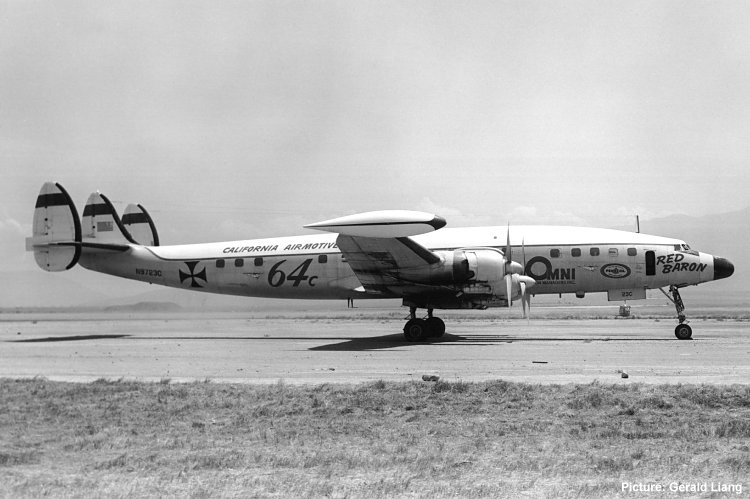
Lockheed L-1049G Super Constellation N9723C, which once served Qantas
as VH-EAP "Southern Zephyr", was prepared for the San Diego race by
its owner Allen Paulson, President of California Airmotive Inc. In
addition to the race number 64c, the Connie carried the name "Red
Baron" on the nose and a large black iron cross on the rear fuselage.
The logos of sponsors, Pennzoil and Omni (an aircraft broker) complemented
the race markings. The Connie was crewed by Allen Paulson and famed
Lockheed test pilot Herman "Fish" Salmon. The flight engineer was
Chuck Mercer (an experienced Lockheed engineer). The "Red Baron" qualified
for the race, rounding the pylons at 200 feet. There are varying reports
of what transpired when race day arrived. One report suggests that
several pilots who had been beaten by the DC-7 at Mojave the previous
year objected to the presence of the DC-7 and the Connie, ostensibly
on the grounds of wake turbulence, and that both aircraft were scratched.
Other reports suggest that Lacy and Salmon elected not to race, although
Lacy did demonstrate the DC-7 in a race with a dragster!
Chuck Mercer, the Flight Engineer on the 'Red Baron', recalled in
August 2005:
"ALL the pilots of the 'small' aircraft held a meeting the night
prior to the race, and advised Darryl Greenamyer, who was in charge
of the race arrangements, that if the two big airplanes participated...
then they wouldn't! As a result - Fish Salmon and I, together with
the Snoopy folks, watched the race from the 'pits'. We subsequently
enjoyed the big dinner at the Hotel Coronado and the good-natured
kidding that took place".
Sadly, the ultimate propliner spectacle was never to be, and we are
left wondering what might have been.
References
"Racing
Planes and Air Races" 1971 & 1972
by Reed Kinert (Aero Publishers) |
"Directory
of Unlimited Class Pylon Air Racers"
by Jim Larsen (American Air Museum) |
| "Air
Progress" December 1971 |
"The
Lockheed Constellation Series"
by Peter Marson (Air-Britain) |
| Issue |
Date |
Remarks |
| 2 |
15AUG05 |
Added
Chuck Mercer's recollections of the reason why the
Connie and the DC-7 did not race.
|
| 1 |
13JAN00 |
Original
Issue
|
|