Eleven
Fuel Tanks!
| Table 1 shows the fuel tank capacities of the Altair in U.S. gallons (U.S.G.) and Imperial gallons (I.G.) This information was derived from various sources as listed below. The table also shows the weight of fuel for each individual tank in pounds (LBS) . |
| TABLE 1 |
U.S.G.
|
I.
G.
|
LBS
|
SOURCE
|
| 1 Main Fuselage Tank |
240
|
200
|
1440
|
A
|
| 4 Standard Wing Tanks |
124
|
103
|
744
|
B
|
| 1 Extra Fuselage Tank |
110
|
92
|
660
|
C
|
| 2 Extra Wing Tanks (ea 16 US) |
32
|
27
|
192
|
D
|
| 2 Wackett Wing Tanks (See Note 3) |
91
|
76
|
546
|
E
|
| 1 Wackett Fuselage Tank (See Note 3) |
24
|
20
|
144
|
E
|
| TOTAL: |
621
|
518
|
3726
|
. |
| Table 2 is based on the following drawing which appeared in "The Courier-Mail", published in Brisbane on 26th October 1934. The caption states that the drawing is based on information supplied by Sir Charles Kingsford Smith. It will be noted that the tank capacities are very similar to those shown in Table 1. |
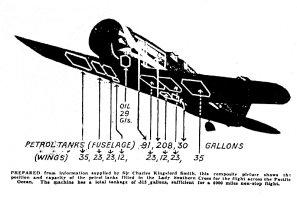
(Click
on image for a larger view)
| TABLE 2 |
U.S.G.
|
I.G.
|
LBS
|
SOURCE
|
| 1 Main Fuselage Tank |
250
|
208
|
1500
|
F
|
| 4 Standard Wing Tanks (ea 23 imp) |
110
|
92
|
660
|
F
|
| 1 Extra Fuselage Tank |
109
|
91
|
654
|
F
|
| 2 Extra Wing Tanks (ea 12 imp) |
29
|
24
|
174
|
F
|
| 2 Wackett Wing Tanks (See Note 3) |
84
|
70
|
504
|
F
|
| 1 Wackett Fuselage Tank (See Note 3) |
36
|
30
|
216
|
F
|
| TOTAL: |
618
|
515
|
3708
|
. |
|
SOURCES
|
|
|
A
|
P.G. Taylor "Pacific Flight" p. 226 |
|
B
|
J.P. Juptner "U.S. Civil Aircraft" |
|
C
|
Lockheed Engineering Change Order #371 dated 22MAY34 |
|
D
|
Lockheed Engineering Change Order #372 dated 23MAY34 |
|
E
|
Transcript of lecture by Sir Lawrence Wackett, Sept 1974 |
|
F
|
Drawing of the Altair fuel tanks based on information provided by Smithy and published in "The Courier-Mail", Brisbane 26OCT34. |
|
NOTES
|
|
|
1
|
To convert
Imperial to U.S. gallons, multiply by 1.2 To convert U.S. to Imperial gallons, multiply by 0.8327 |
|
2
|
One U.S. gallon of gasoline weighs 6 pounds |
|
3
|
Smithy and P.G. Taylor both claim that Wackett added only two (2) extra wing tanks, whereas Wackett himself later claimed , in a 1974 lecture, that he added four (4). It is believed that this recollection was incorrect. However, all three basically agree on the total capacities of the extra tanks. It should be noted that the two Wackett wing tanks were removed by Lockheed after the Pacific flight although the Wackett fuselage tank under the pilot's seat was retained. (See "How Many Wackett Tanks?" below) |
|
4
|
Figures in bold type are primary data. Corresponding figures are conversions |
How
Many Wackett Tanks?
|
Although most sources
state that Wackett added three tanks to the Altair (2 wing, 1 fuselage),
Sir Lawrence Wackett himself later claimed to have added five tanks
(4 wing, 1 fuselage). The following message, sent in response to
a request from the Controller of Civil Aviation, by the District
Superintendent of Civil Aviation at Mascot (Sydney) on 10th October
1934, provides another perspective: Considering that this message was sent within a day or so of a first hand observation (of 2 wing tanks), it must be given greater credence than Sir Lawrence Wackett's recollection (of 4 wing tanks) forty years after the event! However, it should be noted that there is an apparent error in DSCA's addition and he has also failed to allow for the weight of crew, equipment, radio and oil as stated on the Australian CofA. Furthermore, it will be noted that the stated capacities of the added tanks are at variance with those derived from other sources. This raises the question of whether or not Wackett and/or Smithy were forthcoming with accurate capacities or if the DSCA estimated the capacities of the three added tanks. Whilst we may never have a definitive answer, it can be seen from the following table that the maximum variance in the total capacity of the three Wackett tanks is only a mere 8 gallons.
The DSCA's Weight CalculationsAs there are several anomalies with the weight calculations in the DSCA's message, we need to examine these. As mentioned previously, in addition to an apparent arithmetical error, no provision has been made for crew, equipment, radio and oil.
By adding the weight of crew, equipment, radio and oil (from the CofA) and by reducing the total fuel to 3708 lbs as calculated in Table 2, we arrive at the following:
Again, we may never have a definitive answer, but the preceeding figures suggest that the Altair, in its Pacific flight configuration, may have been significantly heavier than estimated by the DSCA. |
| Issue | Date | Remarks |
|---|---|---|
| 3 | 03JAN01 |
Added
information regarding removal of Wackett wing tanks.
|